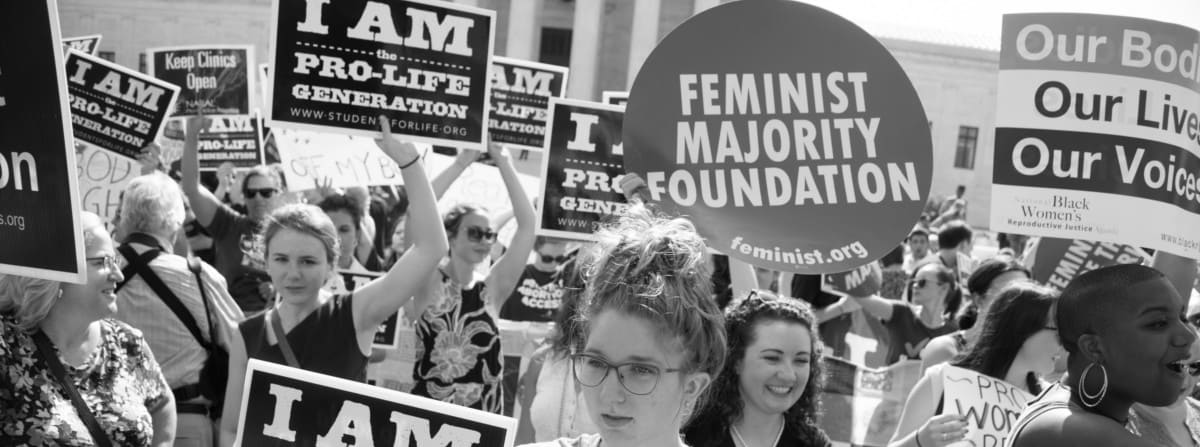
The debate over whether abortion should be a legal option has long divided people around the world. Split into two groups, pro-choice and pro-life, the two sides frequently clash in protests.
Proponents of legal abortion believe abortion is a safe medical procedure that protects lives, while abortion bans endanger pregnant people not seeking abortions, and deny bodily autonomy, creating wide-ranging repercussions.
Opponents of legal abortion believe abortion is murder because life begins at conception, that abortion creates a culture in which life is disposable, and that increased access to birth control, health insurance, and sexual education would make abortion unnecessary.Read more background…
Pro & Con Arguments
Pro 1
Abortion is a safe medical procedure that protects lives.
The death rate for legal abortions is 0.7 deaths for every 100,000 abortions. By contrast, there are one to two deaths per 100,000 plastic surgery procedures, three deaths for every 100,000 colonoscopies, and three to six deaths per 100,000 tonsillectomies. Childbirth has nine deaths per 100,000 deliveries. [236]
The “abortion pill” (Mifeprex) has a better safety record than common over-the-counter drugs including Tylenol, as well as prescriptions like penicillin and Viagra. Medication abortion (a combination of Mifeprex and Misoprostol) has a mortality rate of 6.5 deaths per one million patients. [237] [238]
Pregnancy-related maternal deaths could increase 20% in US states with abortion bans. Amanda Stevenson, Sociology Professor at the University of Colorado, Boulder, explained, “People with resources are more likely to make it out of state or find out about medication abortions. People who can’t are more likely to have health issues, to live in poverty and have less access to resources.” People of color are especially likely to be in the latter category and, thus, negatively impacted by abortion bans. [239]
The predicted 20% maternal death rate does not include those who will die from “back alley” or illegal abortions because legal options were not available. [239]
Globally 45% of abortions are unsafe, 97% of which take place in developing countries. According to the World Health Organization (WHO), “Evidence shows that restricting access to abortions does not reduce the number of abortions; however, it does affect whether the abortions that women and girls attain are safe and dignified. The proportion of unsafe abortions are significantly higher in countries with highly restrictive abortion laws than in countries with less restrictive laws.” [240]
Read More
Pro 2
Abortion bans endanger healthcare for those not seeking abortions.
Medical treatment for nonviable pregnancies is often exactly the same as an abortion. [241] [242] [243]
Ectopic pregnancies occur when a fertilized egg implants somewhere other than the uterine cavity. About one in 50 pregnancies are ectopic, and they are nonviable. Bleeding from ectopic pregnancies caused 10% of all pregnancy-related deaths, and ectopic pregnancies were the leading cause of maternal death in the first trimester. [241] [244] [245] [246]
Other pregnancies can be nonviable, including when there is little or no chance of the baby’s survival once it is born or if the baby has died in utero. The treatment for ectopic and other nonviable pregnancies is often the same as that for an abortion. [243] [247]
One out of every ten pregnancies ends in miscarriage. The drugs used for medication abortions are the only treatment recommended for early miscarriages. For later or complicated miscarriages, the same surgical procedure used for abortions is recommended. [242]
While some abortion bans include specific exceptions for nonviable pregnancies and miscarriages, other bans are too vague to be practicable. Healthcare providers may refuse to perform a procedure that could be interpreted as an “on-demand” abortion for fear of liability or prosecution. [248]
Arguing that doctors and others use them as loopholes for “on demand” abortions, lobbyists are working to eliminate exceptions altogether, which would further endanger and traumatize people seeking care for dangerous medical conditions. [246] [248]
Some pharmacists have refused to fill prescriptions for miscarriages and ectopic pregnancies, because the drugs can also be used for abortion. In Texas, pharmacists can be sued for “aiding and abetting” an abortion. [242] [245]
Further, bans are a slippery slope to contraceptive and other healthcare restrictions. For example, some already wrongly view Plan B (the morning after pill) as an abortifacient and are thinking of including it in abortion bans. [249]
Read More
Pro 3
Abortion bans deny bodily autonomy, creating wide-ranging repercussions.
US Treasury Secretary Janet Yellen stated, “eliminating the rights of women to make decisions about when and whether to have children would have very damaging effects on the economy and would set women back decades…. In many cases, abortions are of teenage women, particularly low-income and often Black, who aren’t in a position to be able to care for children, have unexpected pregnancies, and it deprives them of the ability often to continue their education to later participate in the workforce.” [250]
After being denied an abortion, household poverty increased and lasted four or more years, resulting in an inability to cover basic expenses including food, housing and transportation. A denied abortion was associated with a lowered credit score, increased debt, and an increase in negative public records including evictions and bankruptcies. The households were also more reliant on government assistance. Transgender and nonbinary people denied abortions may face even worse outcomes. [251] [252] [253]
And the consequences can be much more dire. “If a woman of childbearing age dies, it has enormous economic consequences…. It’s someone who society has invested in and who has many productive economic years ahead of them,” according to David Slusky, Associate Professor of Economics at the University of Kansas. Often, death also removes a wage-earner and caregiver from the household. [252]
60% of women seeking abortions already had other children. Being denied an abortion worsened the well-being of their older children, including not meeting childhood development markers. [251]
Women denied an abortion were more likely to have serious health complications, have poor physical and mental health for years afterward, and stay with abusive partners. Women denied abortion were more likely to be raising their children alone five years later. [251] [254]
The Turnaway Study concluded, “Abortion does not harm women,” and “Women who receive a wanted abortion are more financially stable, set more ambitious goals, raise children under more stable conditions, and are more likely to have a wanted child later.” [251] [254] [255]
Read More
Con 1
Life begins at conception, making abortion murder.
Conception is the moment a sperm cell fertilizes an egg cell, which begins the process of cell division that creates a human. [256]
Tara Sander Lee, Senior Fellow and Director of Life Sciences at the Charlotte Lozier Institute, stated, “life begins from the moment of conception when the sperm fertilizes the egg, because there is the creation of a new, totally distinct, integrated organism or a human being, which is going to be biologically distinct from all other life forms on this planet.” The first cell is biologically distinct because it has its own DNA that is different from either biological parent and all other humans. [257]
Ending a life is murder legally and ethically, even a life that is only a few growing cells at the time of death.
Pope Francis explained, “Abortion is murder. Those who carry out abortions kill…. At the third week after conception, often even before the mother is aware (of being pregnant), all the organs are already (starting to develop). It is a human life. Period. And this human life has to be respected. It is very clear…. Scientifically, it is a human life.” [258]
That people may face difficulties without abortion as an option does not excuse or justify murder. A reader of The Atlantic, who gave only the initial K., clarified the moral dilemma: “I wish that I could be pro-choice because the awful circumstances so many women face—that I can’t even imagine facing—seem so much more real to me than the rights of a fetus who doesn’t even always look human. But abortion is the intentional killing of a human being and we look back with horror at anyone in history who decided a group of people did not actually count as people. We cannot solve the problem of injustice against women with more injustice. We need solutions that support women without killing fetuses.” [295]
Read More
Con 2
Legal abortion promotes a culture in which life is disposable.
Echoing a 2014 remark by Pope Francis that connected abortion to “throwaway culture,” Cardinal Joseph Tobin of Newark, New Jersey, stated, “abortion represents a failure to recognize the sanctity of human life and promotes a culture in which human life in its most vulnerable moment is perceived as disposable. Such a proposal targets poor women as needing an expedient solution to a complex problem.” [260]
Tobin previously declared legal abortion a “brutalization of the American heart” on par with the “dehumanization of the undocumented” immigrants. [261]
Alveda King, former Georgia state representative and niece of Martin Luther King, Jr., also connected abortion to other societal ills: “Abortion and racism are both symptoms of a fundamental human error. The error is thinking that when someone stands in the way of our wants, we can justify getting that person out of our lives. Abortion and racism stem from the same poisonous root, selfishness. We create the deceptions that the other person is less important, less worthy, less human. We are all fully human. When we face this truth, there is no justification for treating those who look different than us as lesser beings. If we simply treat other people the way we’d like to be treated, racism, abortion, and other forms of inhumanity will be things of the past.” [262]
As King notes, some fetuses are treated as less than human. This ideology combined with legal abortion could create a slippery slope to designer babies, gender selection, termination of disabled but healthy fetuses, and other trait-selection-based abortions. The slippery slope can then extend to the mentally disabled and elderly in general.
[262]“[A]bortion is an act rife with the potential for eugenic manipulation,” according to US Supreme Court Justice Clarence Thomas. “Technological advances have only heightened the eugenic potential for abortion, as abortion can now be used to eliminate children with unwanted characteristics, such as a particular sex or disability.” [263]
Read More
Con 3
Increased access to birth control, health insurance, and sexual education would make abortion unnecessary.
Abortion rates in the United States have fallen at what the CDC called a “slow yet steady pace” since a peak in 1981. That year there were 29.3 abortions per 1,000 women aged 15-44. The rate fell to 11.4 abortions per 1,000 women in 2019. [264] [265]
Experts largely contribute the decline in abortions in the United States and elsewhere to the improved safety and availability of LARC (long-acting reversible contraception) including IUDs and contraceptive implants that can last up to 10 years. [264] [266] [267]
Access to health insurance to pay for contraceptives also contributed to a drop in abortions. With the passage of Obamacare (Patient Protection and Affordable Care Act), more people were insured with access to free or low-cost contraceptives and reproductive care. [264]
Linda Rosenstock, Public Health Professor of Health Policy and Management at UCLA, summarized the simplicity of the connection: “In the United States each year, about half of pregnancies are unintended and about 40% of those lead to abortion. Access to birth control leads to fewer abortions.” [264]
Further, teens are having sex later in life than their parents. 38.4% of American high schoolers reported they have had sex (down from 54% in 1991) and only 27.4% reported they were currently sexually active (37.5% in 1991). [268]
Because teen birth control use has not increased significantly, experts attribute the decline in part to better sex education. A 2021 study found that students who received comprehensive sexual education initiated sex later than students who did not participate in sex ed. The later teens have sex, the less chance there is for them to become pregnant unintentionally, which leads to fewer abortions. [264] [268] [269]
Historically, abortion was a popular means of birth control and family planning due to a lack of reliable contraception, education, and other resources, and the fact that childbirth was incredibly dangerous. Better options are now available, including more effective birth control, better healthcare and health insurance, and sex education to ensure an unwanted pregnancy does not happen in the first place. [264] [270]
Read More
| Did You Know? |
|---|
| 1. Throughout much of Western history, abortion was not considered a criminal act as long as it was performed before “quickening” (the first detectable movement of the fetus, which can occur between 13-25 weeks of pregnancy). [86] |
| 2. In 1821, Connecticut became the first US state to criminalize abortion. [90] |
| 3. The death rate for legal abortions is 0.7 deaths for every 100,000 abortions. By contrast, there are one to two deaths per 100,000 plastic surgery procedures, three deaths for every 100,000 colonoscopies, and three to six deaths per 100,000 tonsillectomies. Childbirth has nine deaths per 100,000 deliveries. [236] |
| 4. Abortion rates in the United States have fallen at what the CDC called a “slow yet steady pace” since a peak in 1981. That year there were 29.3 abortions per 1,000 women aged 15-44. The rate fell to 11.4 abortions per 1,000 women in 2019. [264] [251] |
| 5. 60% of women seeking abortions already had other children. [251] |


| People who view this page may also like: |
|---|
| 1. Should Euthanasia or Physician-Assisted Suicide Be Legal? Top Pro and Con Quotes |
| 2. Religious Views on the Death Penalty |
| 3. US Religious Views on Abortion |
